I ended my last note with two requirements for estimating a key’s one-hit wonder probability from a stream. I claimed that I needed (1) a square-integrable distribution of hits over a keyspace and (2) a space-efficient way to store an estimate of for all keys. Today I’ll sketch out two alternative methods that require only the latter.
Definitions:
- Set of Possible Keys (“keyspace”):
- Distribution over keys :
- One Hit Wonder Prob.:
1 — The first method reduces the scale of the problem from a calculation over keys to one over sets (where ).
2 — In my previous work I’ve used to calculate the probability that a key arrives before . This method uses properties of to give a estimate that runs in constant time with respect to .
With either method, we must find the first two moments of the distribution of before producing . The remainder of the algorithm is quite straightforward, so today we’ll focus on how to find these moments quickly.
def pz_cache_surv_upper_bound(counts, ct_j, n_b, c=0.10):
    m_1, m_2 = calc_moments(counts, ct_j, n_b) # WANT: a _fast_ impl. of calc_moments
    theta = min(1, c / m_1)
return ((1 - theta) * (1 - theta) * (m_1 * m_1)) / m_2While writing this in Go or C will improve these raw numbers, the method scales poorly as increases. This example uses , at we get just . A few non-obvious optimizations to squeeze it down from /call:
Save 4 by calculating using counts rather than probabilities. We get an equivalent result and avoid division.
Save 1.3 by replacing with .
Save 1.3 by removing check if a counter is compared with itself (i.e. avoid ). If is large then adding to the first moment is negligible. If absolutely needed, subtract from the totals on line .
1 — This method assumes that the hit count of a randomly-selected set of keys is a suitable proxy for the count of any key in the set.
We start by initializing counters, one for each of sets. On each , we hash to and increment the corresponding counter. To be clear, we do not maintain a set of keys, we only retain the counts. When is needed, we’ll use these counts to find a lower bound on the probability that ’s set is not one of the next sets represented in the stream. In theory, if is sufficiently large (impractically large, i.e. ) then we can say that stores the true count . See implementation below.
20003 function calls in 0.238 seconds # from cProfile: approx 0.09M RPS

# %lprun -f calc_moments_baseline for _ in range(20_000): calc_moments_baseline(ct_arr, 10, n_b)
Line #  Hits     Time      Per Hit   % Time  Line Contents
==============================================================
1                                           def calc_moments_baseline(ct_arr, ct_j, n_b):
2     20000    3177053.0    158.9      0.5      m_1, m_2 = 0.0, 0.0
3                                               # n.b: avoid division, don't normalize
4    660000  112742090.0    170.8     17.4      for ct_i in ct_arr: # linear w.r.t. num. bins. :(
5    640000  193703330.0    302.7     29.9          w = ct_i / (ct_j + ct_i) # division :(
6    640000  137734325.0    215.2     21.3          m_1 += w
7    640000  192782130.0    301.2     29.8          m_2 += w * w # n.b: avoid call to pow
8     20000    7414227.0    370.7      1.1      return m_1 / n_b, m_2 / n_b
Very bleak performance. I won’t pursue this method further. Luckily, we can improve on this by x by making informed assumptions about the distribution of .
2 — Let’s consider an extension of the previous approach. In the example below, I replace the loop that calculates moments with the implied moments assuming hit counts are distributed evenly across the remaining sets. This runs in constant time and can scale-up to massive keyspaces.
1000003 function calls in 0.484 seconds # from cProfile: approx 2.07M RPS (~25x !!)
# %lprun -f calc_moments_baseline_f for _ in range(20_000): calc_moments_baseline_f(10, n_b, n_req)
Line #      Hits         Time  Per Hit   % Time  Line Contents
==============================================================
1                                           def calc_moments_baseline_f(ct_j, n_b, n_req, imp_var=0.0):
2                                               # even load, x/(x+j) concave on (0,1) implies we
3                                               # overestimate m_1, var=0 impl. m_2 = m_1 * m_1
4     20000    4207325.0    210.4     30.6      u = (n_req - ct_j) / n_b
5     20000    4444157.0    222.2     32.4      m_1 = u / (u + ct_j) # a single call to w(u, ct_j)
6     20000    5085646.0    254.3     37.0      return m_1, imp_var + (m_1 * m_1)
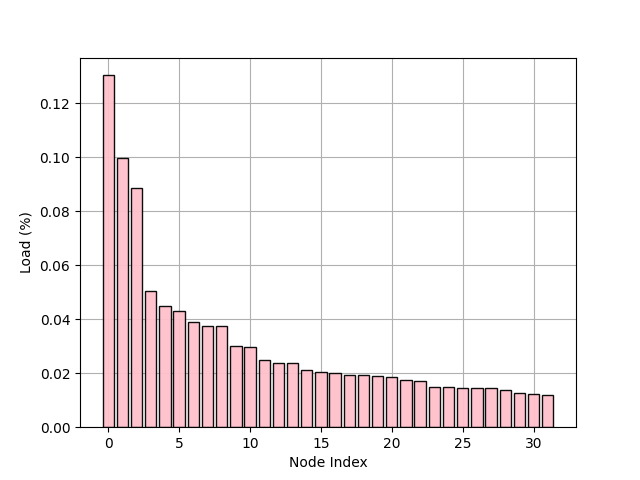
Uniformity in hits is a somewhat unrealistic assumption, can only balance keys across sets, not the corresponding hits.
| — Sets with Uniformly Dist. Keys Can Produce Unbalanced Hit Counts |
|---|
|
Examples of bounding variance via Hoeffeding’s Lemma. If then variance .
- Uniform Hits constant :
- Uniform :
- Maximal Possible:
- Very High Freq. Keys:
To address unequal hit counts across sets, I leave as a parameter to be set by the application. Recall that the following relationship holds for any random variable:
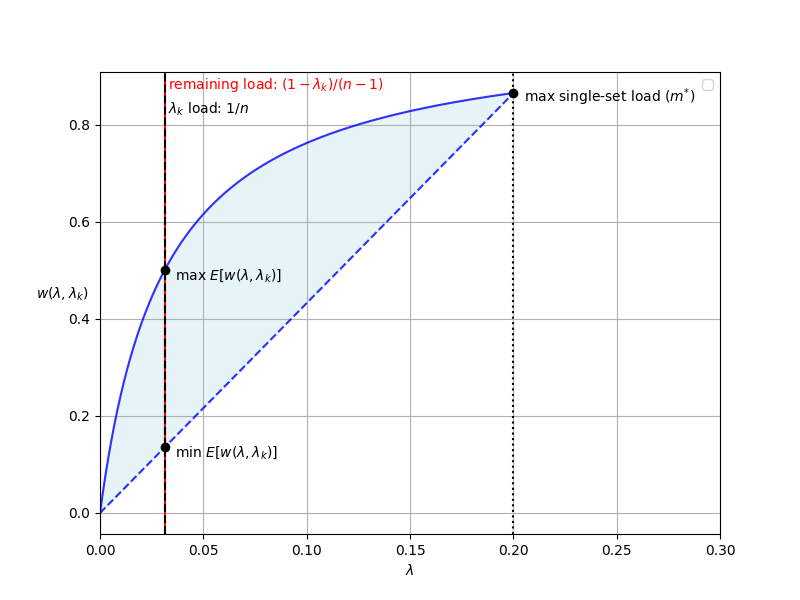
If we have an opinion on the distribution of , we can set this distributions’ variance as to arrive at the second moment without iterating over the set counts. If we so choose, we can also make the first moment configurable. The diagram below provides a visual representation of its possible values for a key with .
: Jensen’s gives us for concave . Because is concave, is the maximal first moment with for all . If we want to really produce the lowest possible , then we can use given a (configurable) max single-set load of .
| — A Justification For Min. & Max Possible Moment |
|---|
 |
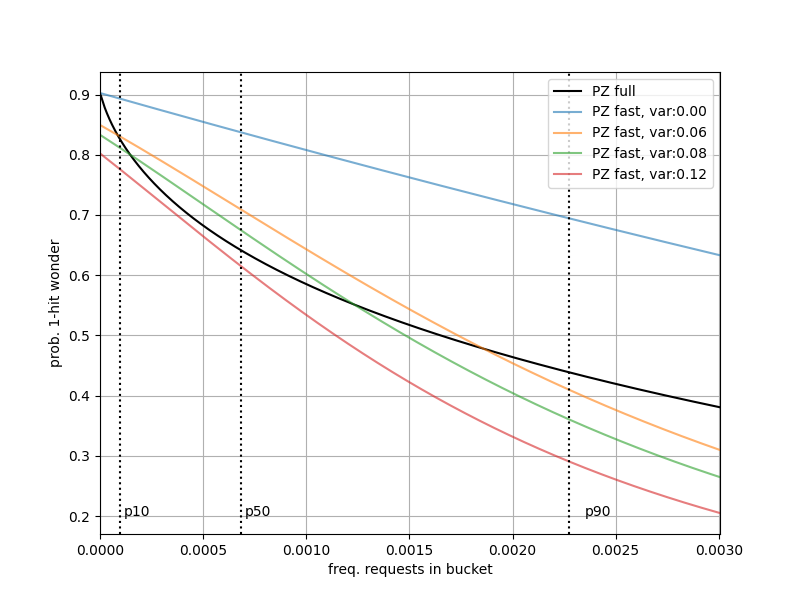
The figure below shows of a set with a hit-count up to the 95th percentile among sets ( total hits, =0.05). Notice that around the median hit count the values are roughly consistent with a variance around . This property isn’t universal across all distributions, but can be useful heuristic for approximating variance as a function of .
| — Sets with Uniformly Distributed Keys & Unbalanced Load |
|---|
 |
To scale this method up to individual keys, I’ll simply replace the count from the code above with a count estimated from a CountMin sketch. Unlike the array of counters proposed in 1, is a data structure that can get an approximate count and sub-linear memory usage. I’ll wrap-up here and leave room for another note after I’ve done a more serious implementation that works in conjunction with a real LRU cache.